Sunday, August 30, 2020

Can a depressed morning turn around?

Today started out as bad day. I woke up worrying about things to do, and then was faced with various other problems that I don't have solutions to. My mind was caught in a loop considering all of the problems that I have, all of the dead ends trying to find solutions to them, and I was just feeling pretty hopeless and miserable.  It wasn't my darkest morning, but definitely not a good one.

In the midst of this, there was a strong temptation to just go along with my usual routine. That would have required spending time with people and making small talk and pretending everything is fine, doing things that I sometimes enjoy, but that I probably wouldn't enjoy this morning.  I wasn't doing too terribly bad. I could have made it through the day. Heck, that is what I usually do and how I got to where I am.

Somehow I recognized that this wasn't going to work today, and that I'd be better off doing something else that might make me feel better.  I enjoy hiking; that has become one of my go to pick-me-up activities.  But it was a Sunday morning, I didn't have a lot of time, and none of the trails nearby sounded exciting.  The only one that called to me at all was 30 minutes drive and would take at least an hour.  No, I wasn't going to do that. I'd just fake it through the day again.

But then, somehow against the prospect of faking it and slogging through the day, I made a choice to do something different.  Before I knew it I was in my car on the way to the trail head.  I put some music on the radio.  I spent some time trying to come to grips with my problems and sort out my feelings, but I didn't make much progress.  However, I wasn't too far down the road before things started looking up.  This windy road to the trail was so fun to drive in my little car.  I thought, "Maybe I should just forget the hike and drive."  A while later I got to the trail head and decided to at least get out and check out the trail.  I started walking/jogging along and the trail didn't disappoint.  It started to feel good to be out, to be sweating, to be jogging down this trail when others just walk.  I tried a little branch off of the trail, to see if I could reach a nearby peak.  That didn't go to well, so I found my way back to the trail.  I don't know when it happened, but on the way back down I saw this view of ferns growing chest-high among the aspen trees.  It was at that point that I realized that I felt truly, sincerely happy.  I wasn't faking it, I felt good. I could see the beauty around me and actually feel it, not just pretend to or say to others that it was nice when I didn't really mean it.

You know what is strange about this, all of the problems that had been bugging me in the morning were still there.  None of that had changed.  Those problems would be there for me again when I got back home.  I may never find solutions to some of them, or at least may have to settle with making a choice between two poor options.  But as I came down the trail I felt better. I was doing what I could to make my life as good as I could, within the constraints that I had. And there were amazing, beautiful things to enjoy and be grateful for.

This is a lesson that has been repeated to me many times as I've struggled to overcome my depression.  It is also something that Jody Moore teaches frequently (and explains so very well  - check out her podcast if you're interested, especially this episode).  We think that our feelings are a product of our circumstances, but they are not.  Our feelings come from our thoughts, and with some learning and a lot of practice we can change our thoughts and feel better even though our circumstances haven't changed.

As you read this, you may be thinking, "I hate hiking, that would never work for me."  If you're thinking that, congratulations - that is awesome that you already know what you like and don't like!  It has taken me a while to get to that point, and even start to figure out what I even liked (I mean besides all of those things that I couldn't have, and which I would dwell on and feel miserable about not having).  At this point I've found a few things I can go to, and I'm working on discovering more.  For you those things may be totally different.  For me so far the key has been to discover what choices I have the power to make that can help me to feel even just a little better.  And then when I want to feel better, to look for something different that I can choose. 

Friday, July 17, 2020

Criminal Justice? - here's a place to start at least

I've seen a lot on facebook and in the news recently about defunding police departments. In my view, to argue to defund police or to argue to double the number of police are both overly simplistic proposals. I came across this article today which does an excellent job of explaining the problem and which solutions work and which do not.

https://papers.ssrn.com/sol3/papers.cfm?abstract_id=1689607

Oh how I wish there were politicians I could vote for who saw crime in this way, rather than simply parroting slogans like "tough on crime" or "defund police". It also makes me think differently about what roles I can have to improve safety.

Thank you to all of you who are police officers and who already see your role in the community as more than just one who gives out punishments.

Sunday, November 17, 2019

Is "God ... is a rewarder of them that diligently seek him"?

Hebrews 11:6
"But without faith it is impossible to please him: for he that cometh to God must believe that he is, and that he is a rewarder of them that diligently seek him."

The part of this verse that struck me recently is the last part - that to come to God we have to believe that he will reward those that seek him.  We have to believe in His goodness and love for us and His desire to bless us abundantly.  The problem is, this can be really hard to do when hard times come, and we pray for relief but don't seem to receive any.

In your darkest times, how do you hope that God will reward you when you come to Him?  How can we help others when they don’t see this?  What would you say to someone who was struggling to believe that blessings (and better times) would come?

Richard G. Scott made some comments in May 1996 that have resonated with me in this regard.   (from "Finding Joy in Life," May 1996 Ensign, https://www.churchofjesuschrist.org/study/ensign/1996/05/finding-joy-in-life?lang=eng )
He gave this talk about one year after the death of his wife Janine.

Sadness, disappointment, and severe challenge are events in life, not life itself. I do not minimize how hard some of these events are. They can extend over a long period of time, but they should not be allowed to become the confining center of everything you do.
Learn from inspiring individuals who have made peace with their challenges and live with joy amid adversity. A lovely woman with an aggressive terminal disease consistently found joy in life. She understood the plan of happiness, had received the temple ordinances, and was doing her best to qualify for the promised blessings. Her personal journal records: “It is a beautiful fall day. I picked up the mail and sat down on the swing. I was so happy and content in the warm sun, the sweet smell of nature and the trees around me. I just sat and gloried in the fact that I am still alive on this beautiful earth. … The Lord is so good to me. How I thank him that I am still here and feeling so good. I am soooooo happy I just want to shout and dance through this beautiful house as the sun streams into the big windows. I love being alive.”
Simple, rejuvenating experiences surround us. They can be safety valves to keep the tension down and the spirit up. Don’t concentrate on what you don’t have or have lost. The Lord promised the obedient to share all that He possesses with them. You may temporarily lack here, but in the next life, if you prove yourself worthy by living valiantly, a fullness will be your blessing. 
Find the compensatory blessings in your life when, in the wisdom of the Lord, He deprives you of something you very much want. To the sightless or hearing impaired, He sharpens the other senses. To the ill, He gives patience, understanding, and increased appreciation for others’ kindness. With the loss of a dear one, He deepens the bonds of love, enriches memories, and kindles hope in a future reunion. You will discover compensatory blessings when you willingly accept the will of the Lord and exercise faith in Him.
In spite of all that was just said, don’t expect that it will always bring comfort.  Don’t expect that you will always be able to feel happy or hopeful.  Those difficult times will come and in those moments all of these thoughts will seem to matter little.  Those times must simply be endured.  It is ok if you still feel lost and hopeless at times even with all that you know of the Lord’s promises and goodness. Try to hold on to these thoughts, to notice the compensatory blessings, and when you come out on the other side you will see clearly again.

In a recent talk Elder Holland shared some helpful thoughts.  Watch the video at this link.  The whole thing is great, but I would focus on 10:30 to the end.


I hope there was something here that resonated with you.  

Sunday, November 3, 2019

Peace Through the Gospel

I was assigned to give a talk in church in September 2019 and I thought I would share it here.  Writing this was a learning experience for me and I hope you find it helpful.

(Photo from our trip to Germany in Oct. 2019 - doesn't that look peaceful?)

Peace is always available to us through the gospel.
In John 14:27 the Lord said, “Peace I leave with you, my peace I give unto you: not as the world giveth, give I unto you. Let not your heart be troubled, neither let it be afraid.”  The promise of peace is unique, because it is something that we are actually promised that we will have in this life, while so many other promised blessings are often delayed until later or until the next life. This promise comes in D&C 59:23, where it says, “…he who doeth the works of righteousness shall receive his reward, even peace in this world, and eternal life in the world to come.”  The happiness that the gospel promises (eternal life) may not always come in this life, but we can expect a measure of peace even in this troubled world through the gospel plan.

Peace from the Atonement in the Midst of our Shortcomings
So how do we access the peace that the Gospel promises?  What do we have to do?  I believe that we can have peace in Christ at any time, no matter what we have done.  As we took the sacrament just now, was one of you feeling guilty because you have done something wrong, maybe something seriously wrong.  Or maybe you have tried to change many times and slipped back into the same sins.  Or maybe you now realize that you weren’t even paying attention during the sacrament, and so you feel guilty for that :).  In any event, I believe that each of us can have peace in Christ in this very moment, even if we are struggling with big sins.  Why?
I think this is explained well in a story that Brad Wilcox tells of counseling with a BYU student who was struggling to do all that she felt she needed to do, and be all that she was expected to be, to the point that she just wanted to give up.
She said, “I know I need to do my best and then Jesus does the rest, but I can’t even do my best.”
She then went on to tell me all the things she should be doing because she’s a Mormon that she wasn’t doing.
She continued, “I know that I have to do my part and then Jesus makes up the difference and fills the gap that stands between my part and perfection. But who fills the gap that stands between where I am now and my part?”
She then went on to tell me all the things that she shouldn’t be doing because she’s a Mormon, but she was doing them anyway.

Have you ever felt like that?  I know I have.  It isn’t very comforting to know that Jesus makes up the difference between my best efforts and perfection, because I have no idea what my best efforts are anyway, and even if I did I rarely seem to be able to give them.  To help this girl understand, Brad took out a piece of paper and drew two dots.  One at the top representing where God is, or perfection, and one at the bottom representing where we are.  The gap between is all the sin and mistakes we have to overcome to be like him.  Continuing the story,
I then said, “Go ahead. Draw the line. How much is our part? How much is Christ’s part?”
She went right to the center of the page and began to draw a line. Then, considering what we had been speaking about, she went to the bottom of the page and drew a line just above the bottom dot.
I said, “Wrong.”
She said, “I knew it was higher. I should have just drawn it, because I knew it.”
I said, “No. The truth is, there is no line. Jesus filled the whole space. He paid our debt in full. He didn’t pay it all except for a few coins. He paid it all. It is finished.”

I really like that thought. Christ’s atonement didn’t fill part of the gap, he paid ALL OF THE DEBT.  There is nothing left for you to pay, no minimum that you have to meet.  No matter how many times you mess up, and no matter how dark your sins, he has paid them.  Whatever you were feeling guilty about a minute ago, he paid for that already.
Given the culture that we’ve grown up in, you may be resisting this idea.  You may be saying, there must be some catch, something that is required of us, something that we have to do. So what is it?
After the earthquakes and fires and destruction that accompanied the death of Jesus Christ, as the people sat in the darkness and mourned their losses, they heard the voice of the Lord.  That voice told them of Christ’s sacrifice and began to explain what it meant to them.  It said,
3 Nephi 9:19 And ye shall offer up unto me no more the shedding of blood; yea, your sacrifices and your burnt offerings shall be done away, for I will accept none of your sacrifices and your burnt offerings.  (In other words, those sacrifices that you were making that you thought were to pay for your sins, you can stop them now.  Now I want something different.  The scripture continues to explain what this is.)
20 And ye shall offer for a sacrifice unto me a broken heart and a contrite spirit. And whoso cometh unto me with a broken heart and a contrite spirit, him will I baptize with fire and with the Holy Ghost...

The way this makes sense to me is to say that the plan of Grace really comes down to your heart.  Is your heart pointed towards Christ?  You can change the direction of your heart in an instant, and be reconciled with him and on the right path.  Then peace can begin to be yours in that instant, because you know that you are taking a step towards Him.  There is no list of things you first have to do. The debt is paid, and now you are a debtor to Him.  Will you point your heart towards him and keep trying, and do that day after day, getting back on track when you slip and turn your focus to other things?  It sounds so easy, right?

But this is a two-edged sword.  If we were hoping that we could meet some minimum requirement and get grace now that won’t work.  We can’t cram the night before, the way we would for a school assignment.  We can’t get there by doing things on a checklist, because we might do those things with our hearts still pointed the wrong direction.  There isn’t a faceless, nameless agency holding our debt.  It is now held by a person who paid it personally and knows us, knows all the struggles and baggage we have to overcome, but also knows what we are capable of as well as we do.  Will we turn to him and offer him “a broken heart and a contrite spirit,”?

So what about works?  Can we forget about having to do any good actions?  Well, for one, sometimes the best way to get our heart pointed in the right direction, is to move our feet in that direction!  We’ve all had the experience of not wanting to go to a church activity, or on a ministering visit, but we do it anyway and come home grateful and blessed, more in tune with the Lord.  In a case like that I think that it wasn’t that there was some action that was required on our part, the action just helped us to get our heart pointed in the right direction.

As I have tried to turn my heart to God, it can be difficult to not be overcome by guilt because part of me still really does want to follow the world and not Christ.  Part of me still wants to continue in certain sins.  When I read that a “heart can be changed, so that it has no more desire to do evil” I just feel more guilty because mine has not yet changed.  I’m 40+ years old, shouldn’t I be done struggling with _____ (fill in your favorite sins) by now?  What am I doing wrong?

In other words, we may not find comfort in knowing that grace just comes down to our hearts, because our hearts are rotten also.  It may be tempting to try to just ignore this and put on a happy face, to “fake it until you make it.”  I’ve tried that, and while it worked great for me in my job, it hasn’t worked very well in my relationship with Christ.  What I think has worked better is to try to acknowledge my feelings, honestly look at where I am now, and what I want to be, and to begin to accept both of those with a peaceful heart.  When I do this I can turn to the savior and say, “here is what I was able to offer today.  I know that it isn’t much but I hope you can accept it.  I want to be good and trust and follow you, and so I’ll see if I can offer more tomorrow.”  Then, be prepared for a rollercoaster.  Sometimes tomorrow’s offering ends up being worse than today’s.  But, at least I know that each effort, each attempt to turn to Him is worth something. That brings a measure of peace.  And, slowly, over the course of, say, a year, I can see myself growing closer to Christ, I can see the ways he has helped me to do and be more, and I can begin to believe that with the savior's help it will be enough.  Our best efforts will always be enough, but more importantly, since we never really can give our best efforts, our imperfect efforts are also enough.  He has already paid the price for ALL of our sins. All we have to do now is to keep trying to turn our hearts to God.

Sunday, April 24, 2016

Land of Empty Churches?

(This was written summer 2014, but I just now got to pasting the pictures in so I could post this.)

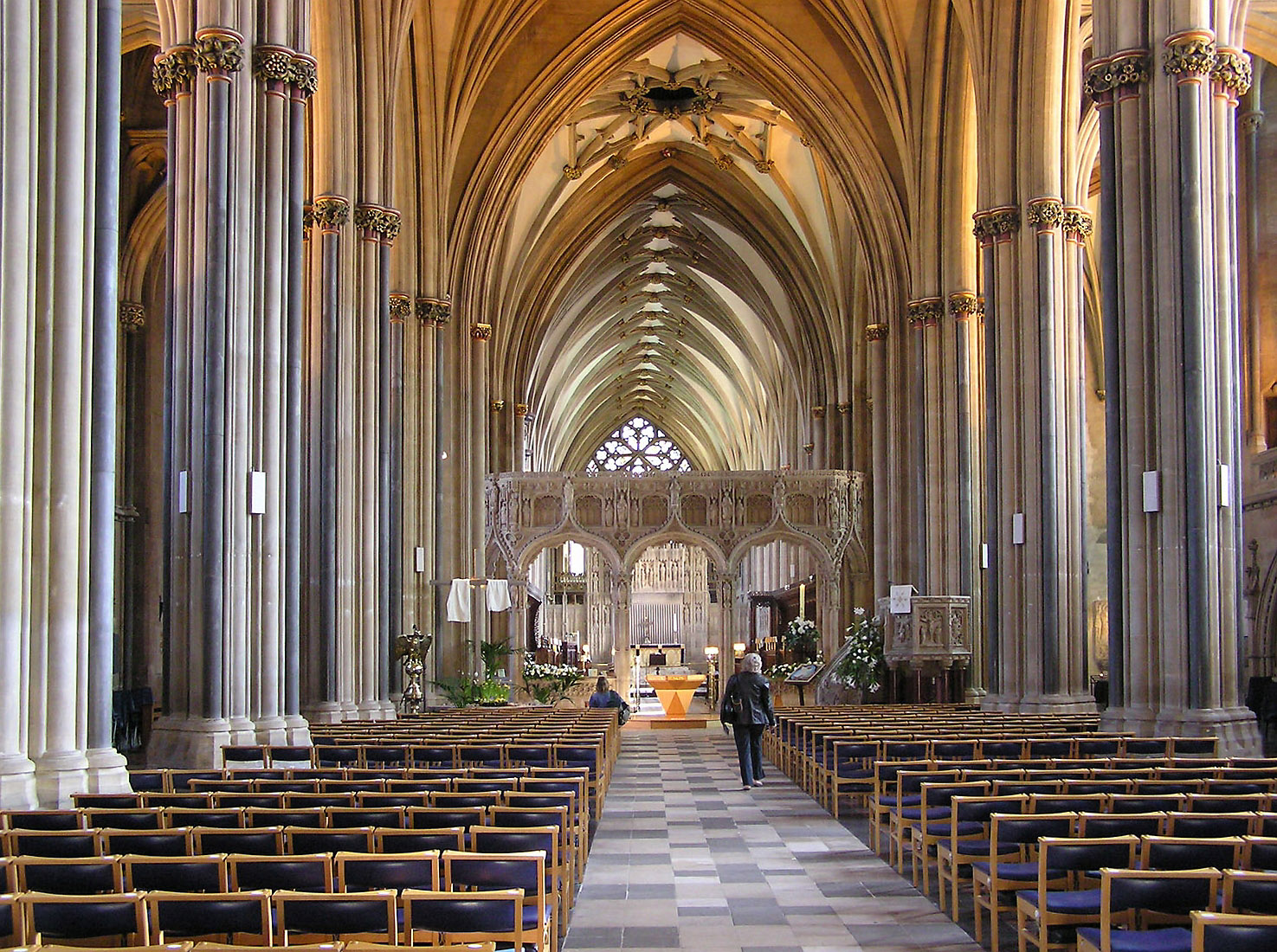
The first thing you notice when you come to the UK, or pretty much to any place in Europe, is that there are so many amazing stone churches and cathedrals, all still standing after hundreds of years.  For example, the picture below shows the Bristol Cathedral, which was founded in 1140 AD.  This church was built over hundreds of years, and has looked about as it does now since the 1500s or so.  Imagine building a church like this before the days of power tools and diamond saws.  When you look at the intricate stone work and the sheer size of the columns and ceiling, it is clear that hundreds of craftsmen must have worked for years to build this.  Was it only another job for them, one by a wealthy customer who was sure to pay, or did they feel that they were building a symbol of their faith, an offering to show their devotion to God?  Surely they must have hoped that their children and grandchildren would come there to worship for generations and would see it as a symbol of their faith.  When I see one of these churches, I can't help but think of the millions of man hours that common people must have devoted to build it, and the wealth that paid for it was the accumulated work of thousands of people who had far less than the poorest among us have now.  They gave to build a church of unimaginable quality, complete with glass windows, intricate stone carving, paintings, stone floor, etc... when they lived in cottages with thatched roofs and dirt floors and perhaps couldn't even afford necessities like food and heating.


It is simply astounding how many of these churches there are.  Just about every little town has a stone church standing at its center, beautiful in its design and craftsmanship.  Below are a few pictures of a church where David Thomas Thorne, Sr., my 5th great grandfather was christened in 1797.  This church is no cathedral but it is still beautifully built and full of fine craftsmanship, all done by hand.  In a larger city like Bristol, many towns have grown together so now there are dozens of churches of varying size.  We could take a half hour walk from our house and see half a dozen all of which were built before our great grandparents were born.


The other thing that is crazy about all of this, is that most of these churches are only barely used now.  In a typical week some are seen by far more tourists than they are by worshipers.  Now would be a good time for an anecdote.  For example maybe I could tell you about the evening service that I went to a few weeks ago at Wells Cathedral, which was attended by fewer than 20 churchgoers, and how my children were the only people in attendance under 35.  That would be great, but I'm an engineer so I prefer solid facts.  The "tear fund" study (http://news.bbc.co.uk/1/shared/bsp/hi/pdfs/03_04_07_tearfundchurch.pdf) found that, while more than half of the people in the UK self identify as Christian, only about 10% attend weekly.  If we relax our standards a bit and are satisfied with once a month attendance, then the percentage of churchgoers increases to 15%.  Interestingly, those in the highest social class have a higher prevalence of attending church, 21-22%, but that is a topic for another day.

So what do we make of this country full of empty churches?  What caused the change?  Each day countless thousands of people pass by these monuments on their way to work, or to get groceries, or they sit on their lawns to enjoy the sunshine.  What do they think of their ancestors who gave their lives to build them? Do they think of them as deluded, primitive people who were not too ignorant to know better?

Certainly there have been many ups and downs in the history of religion in the UK.  It is hard not to be skeptical when we hear of Henry VIII's exploits.  And there are other such stories.  For example we visited the ruins of the castle in St. Andrews where Cardinal David Beaton took refuge from the the rising mobs of reformers.  A group of them snuck into the castle disguised as masons and mounted an attack.  When they forced the door to the cardinal's room they found him trying to hide his gold.  He was killed and probably replaced by another.  Some time later St. Andrews castle fell into ruins (see below).


There are also many stories of noble people who gave all to try to help people come closer to God.  In front of the same St. Andrew's castle we saw a marker on the pavement identifying the place where the reformer George Wishart, was burnt at the stake for his part in the reformation.   In front of another church are the initials of Patrick Hamilton who was also burned at the stake for his preaching as a reformer.


It looks like we'll leave here before I ever come to a satisfactory answer regarding what happened to religion in the UK.  But as I walk the streets here, I can't help but wonder sometimes if people are really happier now that they pass their Sunday mornings on the lawn rather than in the church.  Don't they sense that something is missing?  Can any of us be truly happy while believing that life is just a chance of chemistry and biology, that will come to a complete and final end when we take our last breath?  Can any amount of entertainment and joking around with friends fill the void?

Wednesday, March 2, 2016

Studio C Favorites

I have a confession to make.  I am now officially a Studio-C-aholic.  Completely and utterly a fan, no, more than a fan, an addict.  What amazes me is how many people there are in this wide world that haven't yet discovered Studio C.  You are all really missing out.  In case you've never connected with Studio C, and in honor of Natalie Madsen's visit to Madison last week, I put together a top-10 list of some of my favorite sketches.  If you don't have a stitch in your side by the time you get to #1 then there may be something wrong with you.
#10

#9


#8


#7


#6

Ok, so this one is actually two videos.  The sequel is my favorite but you have to see the original first:


#5

#4
#3

#2


#1


So, if you are still reading at this point, then you may enjoy the following video by this same group, before they made it big :) as Studio C.


Saturday, July 11, 2015

I see you celebrating the Supreme Court’s decision on gay marriage and wish I could celebrate with you, but I can’t


            Since the US Supreme Court’s decision last Friday on Obergefell vs. Hodges, I’ve seen the media flooded with images and stories of many of you celebrating the fact that the United States now recognizes your relationships and will extend to them all of the privileges that have been offered to traditionally married couples.  Even more potent, I’ve seen many of you, friends who I know and care about, sharing your feelings and experiences on social media. You look so happy, and I can imagine that I would feel the same in your shoes.  You’ve found love, companionship and romance, all of those things that we dream of in movies, books and pop songs.  So why can’t I celebrate with you? Why do I feel sad instead?  I’ve written down a few ideas, both to help me more fully understand how I feel, and I hope that it might help you to understand where I’m coming from when disagreements arise between us.
            First of all, I should explain the beliefs that have shaped my thinking on this issue.  I believe that we are all  children  of a Heavenly Father and Mother and they sent us here so we could have certain experiences and eventually grow up to become as they are.  Part of that involves each of us finding a second half, so that together we can be like our heavenly parents, God the Father and God the Mother, and create a world where our own children can go and find the experiences they need to grow into their potential.  I believe that the gender that God gave us is a part of our identity, and that just as it is impossible for two men to marry and create children on this planet, it will likewise be impossible for a same gender couple to experience all that God has in store for them.
            So, you see, that even if I were to celebrate with you now, and even if I am touched to see the love that you share with each other and all the good things that you do for your partner and the good that you two do on this planet, I know that someday this life will end and you and your partner will not be able to create your own eternal family.  You would have a very difficult choice.  You could choose to part ways and leave a life full of love and shared experiences behind you and go in search of a companion who could complete you spiritually and physically in the way God intended.  Or I suppose you two could continue together and find joy in helping to raise other people’s children but  not have the eternal union that you most desire.  I can’t make the choice for you, but neither of those options sound very appealing to me, and so I can’t celebrate with you with all my heart, but instead I hurt to see you investing physical and spiritual intimacy in a relationship that cannot last.
            But you say that your love is real and that you have found real happiness and fulfillment in this relationship, and when I read your posts and see your smiling faces on Facebook, I believe you.  How could I tell you that this love that you have found is wrong? That instead of embracing it and enjoying it, that your feelings are misdirected?  How can I tell you that you should limit your relationship to friendship, that you should resist the urge to bring sex into it?  How dare I tell you that I believe that the best option for you is to pursue a life without that kind of love in hopes that someday God will make things all right?
           Well, I’m afraid that I don’t have a very satisfying answer to that question.  I don’t know why God would make you this way, or allow you to develop this attraction.  It doesn’t seem fair that others should be able to marry and find fulfillment for both their emotional and sexual desires, but you should be told that you are doomed to hold yours back for the rest of your life.  No, that isn’t fair at all.
            The best I can offer to you is to remind you that you are not quite as alone as you might think.  I know many great women who in spite of their desires to find love and companionship, and to find someone to be their partner in raising a family, are unable to find a suitable companion, and are alone as their youth (and fertility) slips away.  They too face the prospect of going to the grave with so many needs unmet, desires unsatisfied, all for no lack of effort and apparently through no fault of their own.  I’ve also known many people who have followed the recommended path, married the man or woman of their dreams, built a family together, and yet that relationship has crumbled to the point that they can’t imagine being happy again. They’ve made a commitment to their companion that was supposed to last the rest of their life, or even into the eternities, yet now it seems that their companion has no interest in holding up their end of the bargain.  True, it is likely that things will improve if they stick it out and try to reignite a flame in that relationship.  However, for today they face a bleak future and no resolution seems likely to come before they are laid down in their graves.  Aren't  those experiences at least a little bit like yours?
            Now certainly you would say, that if all of those people could just hold on to hope, could just trust that God is in charge, that He can make even the darkest situation work for their good.  That someday when the test is over everything will be made right and their joy will be perfectly and overwhelmingly whole.  It is remarkable how God can do that. He can take a terrible situation and make it blossom.  We have all seen examples of that.  I think of those Jews in concentration camps and all that they suffered through no fault of their own, in fact, they suffered because they were trying to follow God and love Him.  Their story has become an inspiration to me, and strengthened me to hold on when I face what to me seems like a very dark day.  I wonder how they feel about those experiences now that their bodies have been laid down in graves and their spirits have returned home to God?
            And so, as you march down the street among colorful flags and as you tell me touching stories of the love that you have found, and as you rejoice to know that so many have accepted the choice that you’ve made, you may notice me on the sidelines, quiet and a little somber.  I hope you won’t think that I don’t care, and that I’m not happy for you.  It is just that in my minds eye I can see your march leading you into a thunderstorm.  In my view the path that you’ve chosen cannot take you where you would like to go.  I probably can’t make you see things my way, and there will be many who will join you and will have little interest in listening to my warnings.  They will add to my grief.  Actually, I'm morally obligated to do all that I can to try to encourage them to follow a path that leads to a better end.  Unfortunately, that will probably place you and I at odds at times.  I just hope that this little letter might help you to understand why I don’t grab a flag and join the parade, and why I may even have to ask you to turn down the music so those who are marching with you can hear the thunder in the distance.